News

Oil settles lower after rally on pipeline outage; Brent premium narrows

5511224433


HOUSTON (Reuters) – Oil prices fell sharply on Tuesday, as traders took profits after prices surged early to a two-year high on an unplanned closure of the pipeline that carries the largest North Sea crude oil grade.

Selling picked up after the U.S. Energy Information Administration said in its monthly short-term energy outlook that U.S. crude oil output will rise by 780,000 barrels per day (bpd) to 10.02 million bpd in 2018.

Last month, it expected a 720,000 bpd year-over-year increase to 9.95 million bpd.

“The market is respecting what [EIA] is saying but they’re taking it with a grain of salt,” said Phil Flynn, analyst at Price Futures Group.

Volume was strong, with U.S. crude seeing more than 780,000 contracts changing hands, compared with the 200-day moving average of 626,000 contracts.

The WTI-Brent spread widened to as much as $7 CL-LCO1=R, the highest in more than two years, then narrowed to $6.38. WTI has lagged Brent, and the discount has helped boost U.S. exports.

The Forties pipeline, which carries crude from the North Sea to a processing terminal in Scotland, was shut on Monday after cracks were found. Traders believe it is the first unplanned outage for some years in the line, which was scheduled to pump 406,000 barrels per day (bpd) in December.

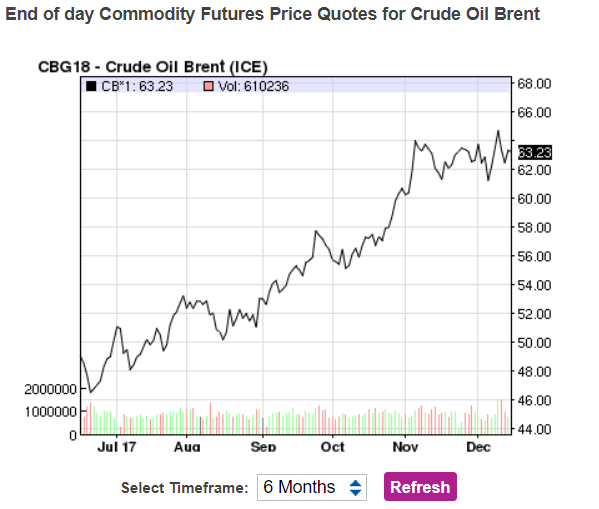
Its closure pushed Brent prices higher on Monday and early on Tuesday, with Brent rising above $65 a barrel for the first time since June 2015.

Forties is important for the global oil market because the crude it carries normally sets the price of dated Brent, a benchmark used to price physical crude around the world and which underpins Brent futures.

Industry group the American Petroleum Institute said on Tuesday that crude stocks fell by 7.4 million barrels, more than expected. [API/S]

But gasoline stocks were up by 2.3 million barrels, and distillate inventories rose by 1.5 million barrels, compared with expectations for a 902,000-barrel gain, the API data showed.

Analysts expect data on Wednesday from the U.S. Energy Information Administration (EIA) to show crude stocks fell 3.8 million barrels last week. [EIA/S]

(This story has been refiled to Corrects settlement price of U.S. crude in second paragraph.)

Oil prices fall after U.S. drillers add rigs

55112233

44


TOKYO (Reuters) – Oil fell on Monday after U.S. shale drillers added more rigs last week, but prices held not far off their highest since mid-2015, supported by an extension of output cuts agreed last week by OPEC and other producers.

A driver looks at the price as he fills the tank of his car at a gas station in Shanghai, China November 17, 2017. REUTERS/Aly Song


Drillers in the United States added two oil rigs in the week to Dec. 1, bringing the total count up to 749, the highest since September, energy services firm Baker Hughes said in its closely followed report late on Friday. RIG-OL-USA-BHI

U.S. West Texas Intermediate CLc1 was down 21 cents, or 0.3 percent, at $58.15 a barrel at 0112 GMT. Brent futures LCOc1 were 22 cents, or 0.4 percent, lower at $63.51 a barrel.

The U.S. rig count, an early indicator of future output, has risen sharply from the 477 rigs that were active a year ago after energy companies boosted spending plans for 2017.

Drillers were encouraged as crude prices started recovering from a two-year price crash around the same time the Organization of the Petroleum Exporting Countries (OPEC) and some non-OPEC producers including Russia agreed to production cuts a year ago.

On Thursday, producers agreed to extend the output cuts that were due to expire next March until the end of the year, continuing to restrain production by about 1.8 million barrels per day (bpd).

The latest agreement allows for producers to exit the deal early if the market overheats. Russian officials had expressed concern that extending the output cuts might encourage rival U.S. shale firms to pump more crude.

Rising U.S. production has been a persistent thorn in OPEC’s side and the rig increased for a second straight week. [RIG/U]

U.S. production rose to 9.5 million bpd in September, its highest monthly output since 9.6 million bpd in April 2015, according to federal energy data going back to 2005. On an annual basis, U.S. output peaked at 9.6 million bpd in 1970.

Canadian futures gain on higher oil prices (BBD., TRP, ATD.)

5

Nov 21 (Reuters) – Stock futures pointed to a higher opening for Canada’s main stock index on Tuesday as oil prices rose with traders looking forward to next week’s OPEC meeting when major exporters are expected to extend production cuts.

December futures on the S&P TSX index were up 0.3 percent at 7:15 a.m. ET.

Wholesale trade data for September is due at 8:30 a.m. ET.

Canada’s benchmark stock index edged up to a one-week high on Monday as financial and consumer discretionary shares gained ground, while energy and mining stocks were pressured by lower commodity prices.

Dow Jones Industrial Average e-mini futures were up 0.32 percent at 7:15 a.m. ET, while S&P 500 e-mini futures were up 0.28 percent and Nasdaq 100 e-mini futures were up 0.35 percent.


TOP STORIES

Bombardier Inc said on Monday it priced $1 billion worth of seven-year bonds at par with a final yield of 7.5 percent per year, underscoring strong demand for the deal partly slated to retire debt maturing in 2019.

Drug company Concordia overcharged Britain’s health service millions of pounds for an essential thyroid drug by abusing its position as the only supplier, the country’s Competition and Markets Authority said on Tuesday.

Canada Corp has started initial excavation work at the site of an oil spill on its Keystone pipeline in South Dakota but has not yet pinpointed where the leak came from, a state official said on Monday.

ANALYST RESEARCH HIGHLIGHTS

Bombardier: JP Morgan raises rating to “overweight” from “neutral”

Alimentation Couche-Tard: National Bank of Canada raises target price to C$75

TransCanada Corp: CIBC raises price target to C$75 from C$70

COMMODITIES AT 7:15 a.m. ET

Gold futures: $1,277.90; +0.19 pct

US crude: $56.56; rose 0.25 percent

Brent crude: $62.39; rose 0.27 percent

LME 3-month copper: $6864; rose 0.53 percent

U.S. ECONOMIC DATA DUE ON TUESDAY

0830 National Activity Index for Oct: Prior 0.17

1000 Existing home sales for Oct: Expected 5.42 mln; Prior 5.39 mln

1000 Existing home sales percentage change for Oct: Expected 0.7 pct; Prior 0.7 pct

FOR CANADIAN MARKETS NEWS, CLICK ON CODES:

TSX market report

Canadian dollar and bonds report

Reuters global stocks poll for Canada

Canadian markets directory

($1= C$1.28) (Reporting By Debanjan Bose in Bengaluru; Editing by Savio D’Souza)

U.S. oil drilling rig count holds steady this week

rqweee

U.S. energy companies kept the oil rig
count unchanged this week, General Electric Co’s Baker
Hughes energy services firm said on Friday, as some analysts
expect a gradual decline in overall rigs in the fourth quarter
and in 2018.

The rig count, an early indicator of future
output, held at 738 in the week to Nov. 17, still much higher
than 471 rigs a year ago as energy companies boosted spending
plans for 2017 as crude started recovering from a two-year price
crash.
The increase in drilling lasted 14 months before stalling in
August, September and October after some producers started
trimming their 2017 spending plans when prices turned softer
over the summer.
So far in 2017, U.S. crude futures have averaged
almost $50 a barrel, easily topping last year’s $43.47 average.
This week, futures were trading around $56 a barrel after
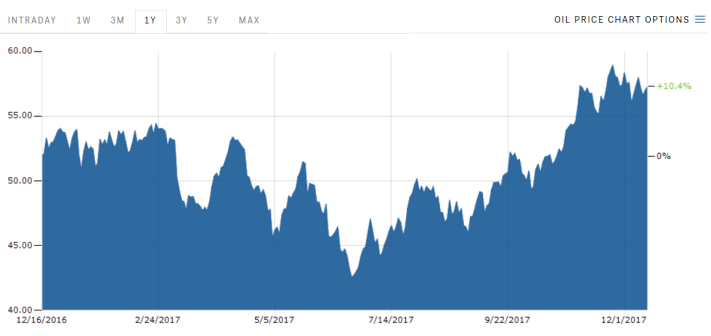
rising close to $58 last week, their highest since July 2015.
Looking ahead, futures were trading near $56 for the balance
of the year and calendar 2018 .
In anticipation of higher prices this year and next than in
2016, exploration and production (E&P) companies increased their
spending on U.S. drilling and completions in 2017 by about 53
percent over 2016, according to U.S. financial services firm
Cowen & Co.

Cowen said 14 of the 64 E&Ps they track have already
provided capital expenditure guidance for 2018 indicating a 9
percent increase in planned spending over 2017.
Cowen, which has its own U.S. rig count, said it expects a
gradual decline in rigs in the fourth quarter of 2017 and in
2018.
There were 915 oil and natural gas rigs active on Nov. 17.
The average number of rigs in service so far in 2017 was 870.
That compares with 509 in 2016 and 978 in 2015. Most rigs
produce both oil and gas.
The total rig count so far in the fourth quarter averaged
915, down from an average of 942 in the third quarter.
The United States, whose upstream energy industry has seen a
resurgence with the development of fracking technology, would
become the “undisputed leader of oil and gas production
worldwide,” the International Energy Agency’s (IEA) head Fatih
Birol said on Thursday.
The U.S. is expected to account for more than 80 percent of
global oil production growth in the next 10 years and it will
produce 30 percent more gas than Russia by that time, the
Paris-based energy watchdog said.
The U.S. Energy Information Administration this week
projected U.S. shale production would rise for a 12th
consecutive month in December to 6.2 million barrels per day.

Overall, U.S. production was expected to rise to 9.2 million
bpd in 2017 and a record 10.0 million bpd in 2018 from 8.9
million bpd in 2016, the EIA said. Output peaked at 9.6 million
bpd in 1970.

There’s a big oil story flying under the radar

bbb


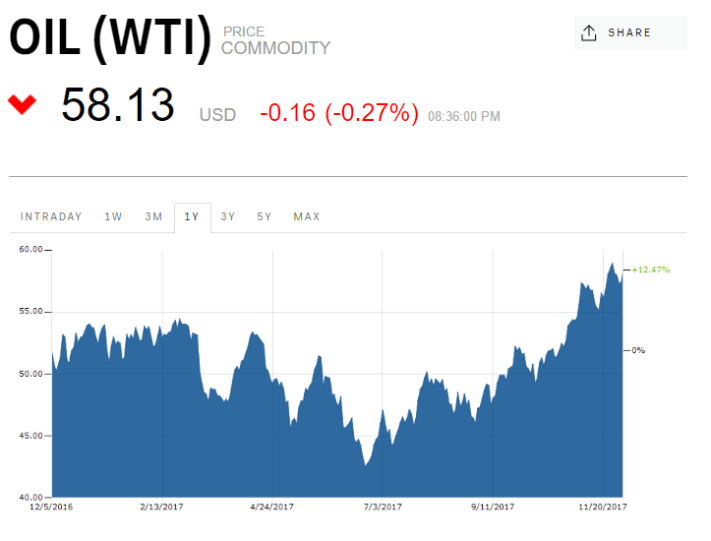
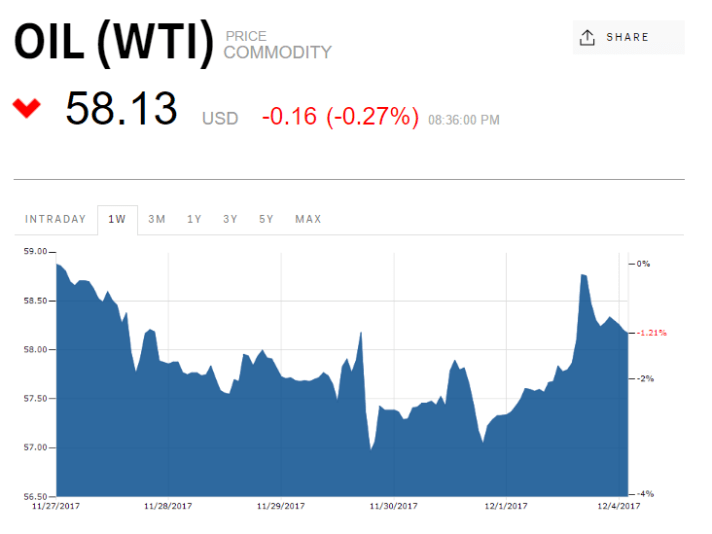
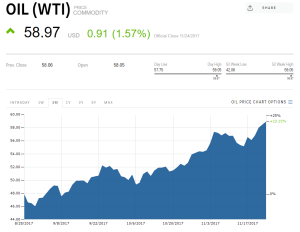
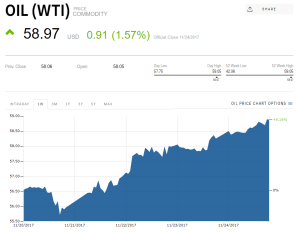
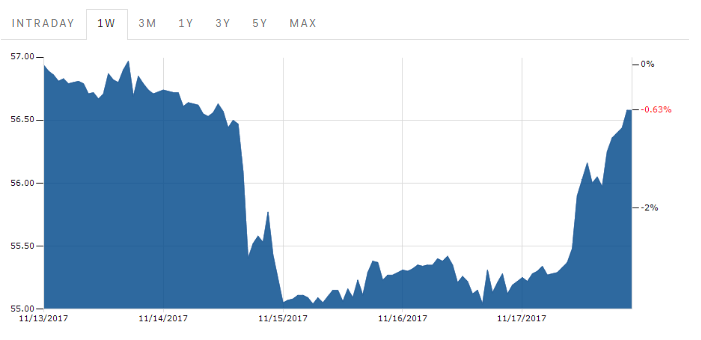
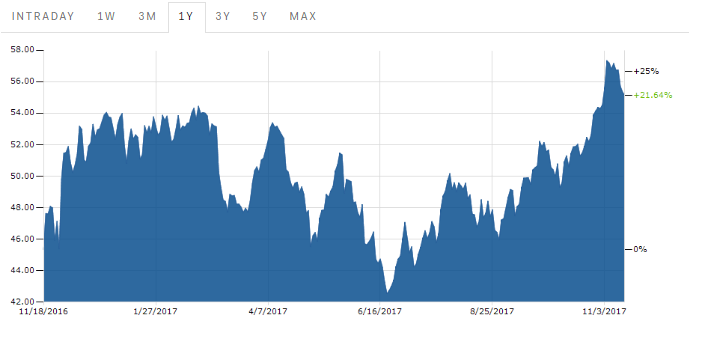
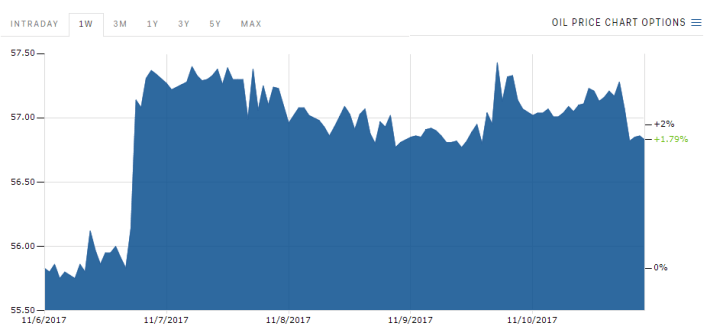
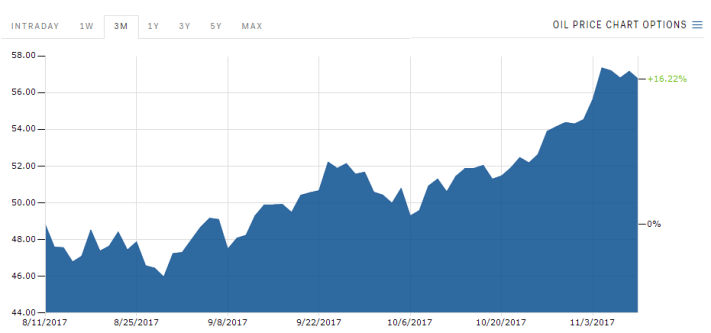
WTI Crude Oil:

zzzxxx


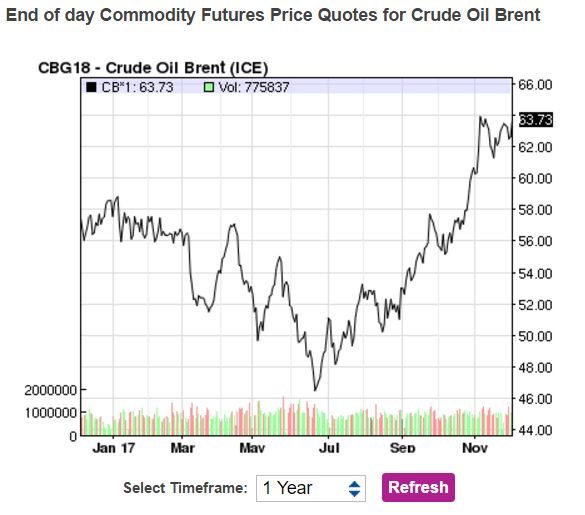
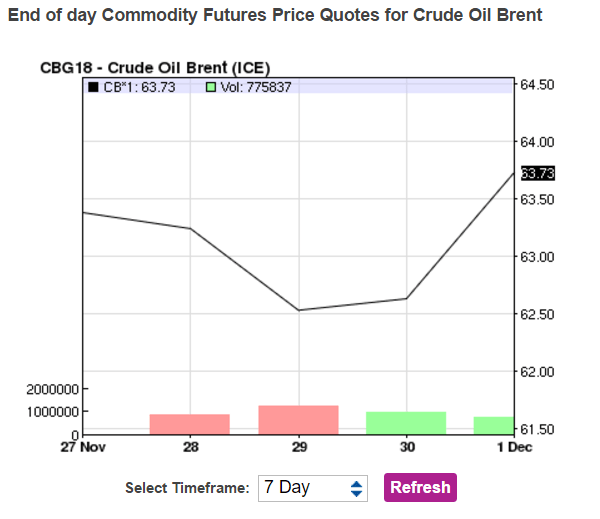
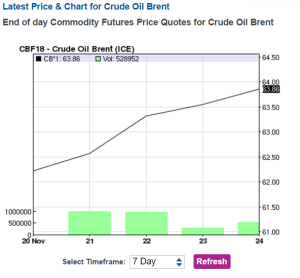
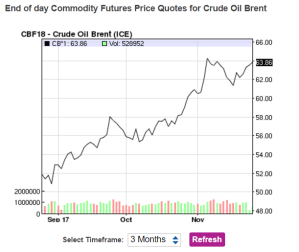
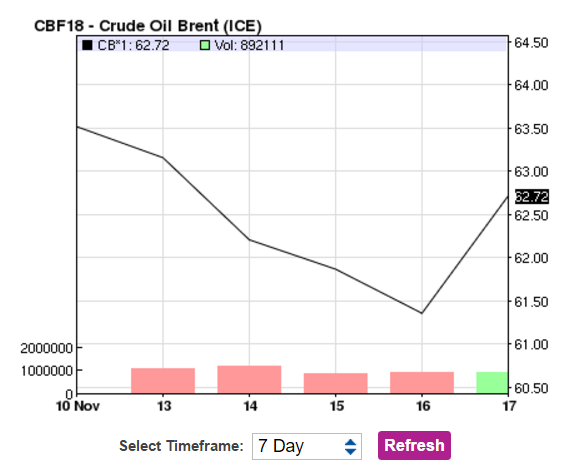
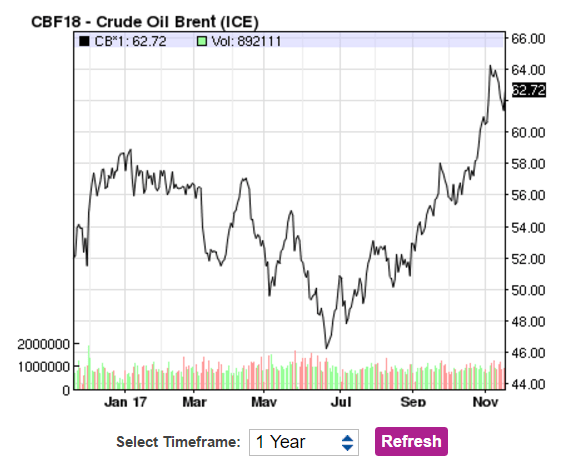
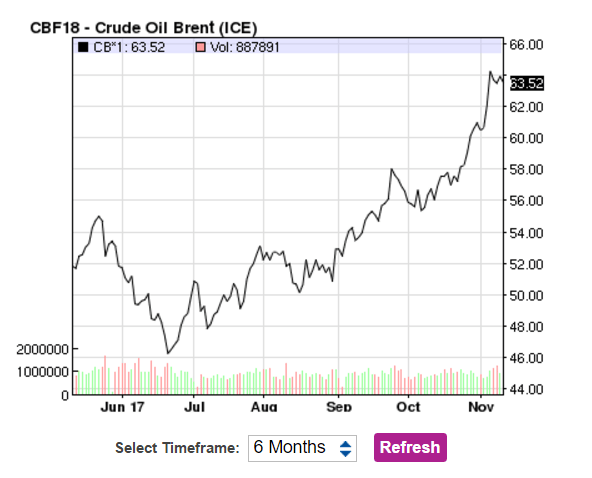
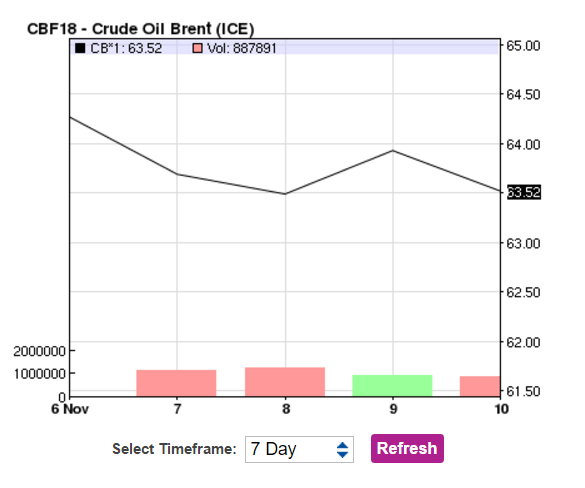
Crude Oil Brent:

cccvvv


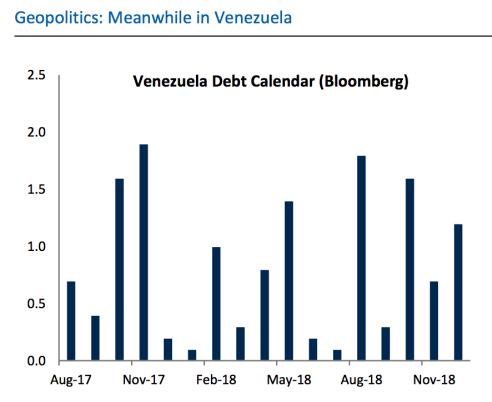
“We caution against taking one’s eye off the looming sovereign debt crisis in Venezuela that could further curtail output from the stressed state,” Helima Croft, head of commodity strategy at RBC Capital Markets, said in a note to clients.

nnn

There’s speculation that Venezuela missed its full $1.1 billion payment on a bond issued by its state-oil company, PDVSA. It was due last Friday, but the Financial Times reports that “while some bondholders said they expected the money to arrive soon, others pointed out that the payment deadline had clearly been missed regardless.”

And last week, President Nicolas Maduro announced Venezuela is aiming to restructure future debt payments, raising questions about the state’s and its oil company’s ability to make the remaining payments in 2017 and 2018.

“Any restructuring effort will be greatly complicated by the August sanctions that bar any US regulated financial institution from dealing in new debt issued by the Venezuelan government or PDVSA,” Croft said.

“Compounding the challenge, the official appointed to lead the debt negotiations, Vice President Tareck El Aissami, was placed on the US Treasury Department’s OFAC sanctions list for drug trafficking in February, potentially putting US regulated firms that engage with him in legal peril,” she added.

Venezuela has been in a deteriorating economic and political crisis, plagued by economic mismanagement, a chronic balance of payments problem, food and essential goods shortages, and looting and violence.

Oil Prices Continue to Gain on Investor Optimism

4-54-14-24-34-4

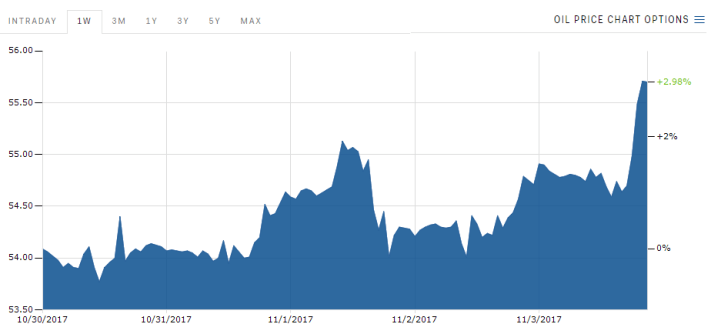
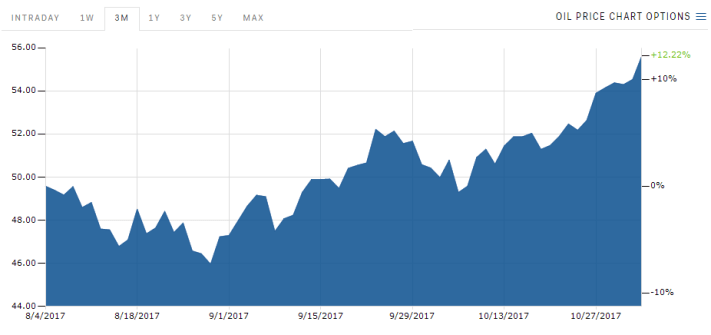
Oil prices advanced to a fresh two-year high Friday, buoyed by expectations for OPEC to extend its deal to cut production and the steady reduction of excess U.S. supply.

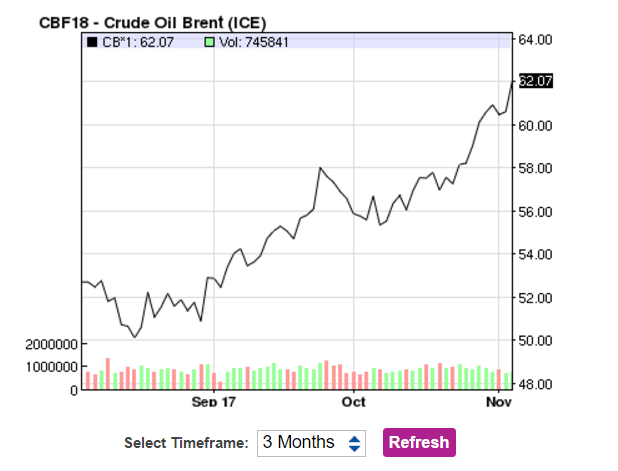
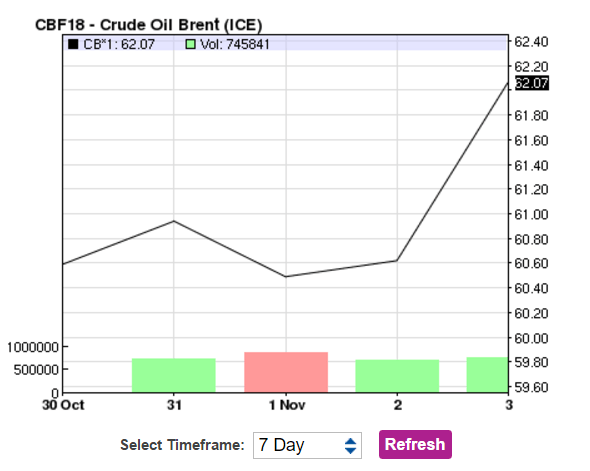
Light, sweet crude for December delivery gained $1.10, or 2%, to $55.64 a barrel on the New York Mercantile Exchange, the highest level since July 2015. Brent, the global benchmark, also rose to another two-year high, settling up $1.45, or 2.4%, to $62.07 a barrel.

The oil market has rallied as investors have been reassured by a decline in crude inventories and strong rhetoric from Saudi Arabia supporting the deal among the Organization of the Petroleum Exporting Countries and other major producers to stick with supply cuts.

Last year, OPEC, along with several other countries including Russia, agreed to cut production by 1.8 million barrels a day to alleviate the global overhang of crude that dragged down prices. Traders are looking ahead to the cartel’s official meeting in Vienna on Nov. 30, to see if producers extend the deal beyond March 2018.

An Iraqi flag on a military vehicle at an oil field near Kirkuk last month.Tensions in the region have supported oil prices. PHOTO: ALAA AL-MARJANI/REUTERS

“I think the prices are already reflecting an extension of the OPEC deal,” said Tariq Zahir, managing member of Tyche Capital Advisors. For now “it’s kind of a wait-and-see game.”

Prices have also gotten a boost from data showing that the amount of crude oil in storage has fallen in recent weeks. On Wednesday, the U.S. Energy Information Administration reported that crude stockpiles fell by 2.4 million barrels in the week ended Oct. 27, extending a trend.

“U.S. inventories are in a destocking mode,” said Dominick Chirichella, an analyst at the Energy Management Institute. “That’s very encouraging.”

Mr. Chirichella added that geopolitical risk has heightened this year, giving rise to concerns of a disruption in oil supply.

“Geopolitical risk is back in the picture in a very clear way,” said Richard Mallinson, an analyst at consultancy Energy Aspects, citing conflict in northern Iraq and Venezuelan financial instability.

Iraqi troops have in recent weeks clashed with forces from semiautonomous Kurdistan, disrupting crude production and exports from the northern, oil-rich region. The conflict was ignited when the Kurds in late September voted nearly unanimously to secede from Baghdad in a controversial independence referendum.

Mr. Mallinson estimated that approximately 300,000 barrels a day of Iraqi production are currently offline.

Meanwhile, Venezuela said Thursday it would seek to restructure its debt. But if the country were to default, the economic fallout would likely engulf the state-owned oil company, Petróleos de Venezuela SA. That could potentially lead to a disruption in oil flows, reducing global supply, according to Mr. Mallinson.

Gasoline futures rose 1.3% to $1.7934 a gallon and diesel futures rose 1.8% to $1.8866 a gallon.


Morgan Stanley: Oil Stocks Are Very Interesting Now

The oil industry is a pretty interesting sector now as it has lagged year to date, it’s under-owned, and has much better value historically, Andrew Sheets, chief cross asset strategist at Morgan Stanley, told CNBC on Friday, joining the growing chorus of other analysts who have recently turned bullish on European and U.S. oil stocks.

The oil sector has lagged the move in oil prices which have been creeping higher and now sit higher than a year ago, Sheets said.

The industry is also interesting because now it is in a very different part of the cycle compared to the very aggressive capital spending when oil prices were $100 per barrel. Now spending is being rolled back and efficiencies have been found, according to Morgan Stanley’s strategist.

Morgan Stanley upgraded the oil sector in Europe to “overweight” a couple of weeks ago, and the bank is also “overweight” on the sector in the U.S., Sheets noted.

“We do think it’s a very interesting sector that is both under-owned and historically much better valued than a lot of other sectors,” the strategist told CNBC.

There is a kind of difficult window for oil prices in the first quarter next year, when new projects and supply is due to come to the market, but demand growth this year has been “incredibly strong.” Morgan Stanley’s current assumption is that the strength in global demand will be enough to offset some of the supply coming online and ultimately, lend some kind of support to oil prices, Sheets said.

Morgan Stanley is joining Goldman Sachs in its view on oil stocks. Earlier this month, Goldman said that shares in oil companies had underperformed the recent oil price rally, so some of those stocks were set to rise in a long-term oil price of $50-55. Goldman Sachs has also recently turned bullish on European majors and on Big Oil’s competitive positioning.

As early as in August, analysts were saying that the oil sector globally is an attractive play for investors right now, with “great value in supermajor oil companies.”

The world’s largest oil trader sees Brent plunging to $45 in 2018

A new wave of surging U.S. production will knock prices lower againCapture


Brent oil prices could tumble more than 20% by 2018, as U.S. output surges and adds renewed pressure on an oil market that is already battling with a persistent oversupply, according to Ian Taylor, chief executive officer at Vitol Group, the world’s largest oil trader.

Speaking at the Oil & Money conference in London on Wednesday, Taylor warned that there’s currently a consensus in the industry that prices will go higher, but that such an unanimity “can be dangerous.”

“We are all expecting a little bit of tightening to come through because we all see demand growing next year at a pretty good rate, we all expect OPEC to hold together and we expect probably the capital disci“So it’s guaranteed we are all going to be wrong. And I think there’s a chance oil could fall closer to $40 than $50, because I think there’s still one more big surge coming from U.S., which will knock prices down,” he said, pointing to $45 per barrel as his 2018 forecast.

Brent prices LCOZ7, +0.05%  traded around $58 on Thursday, so Taylor’s prediction would indicate a 22% slump from current levels.

U.S. shale output has been singled out as one of key reasons oil prices came crashing down in the summer of 2014 and still haven’t recovered to their former glory. Both crude oil CLX7, +0.16% and Brent are still around 50% lower than their 2013-2014 peaks. In response to the price plunge, the Organization of the Petroleum Exporting Countries and a group of non-cartel members have agreed to cut production until March 2018 in an effort to reduce the global supply glut.

However, the U.S. isn’t part of the accord and has been able to grow market share as other global players have frozen or scaled back their output. U.S. shale oil production is expected to rise for an 11th straight month in November, by around 82,000 barrels a day to 6.12 million barrels a day, the U.S. Energy Information Administration said this Monday.

However, not everyone at conference was a downbeat on the outlook for oil. Jeremy Weir, chief executive at commodity trader Trafigura and chief executive for the oil and gas division at Glencore GLEN, +0.79% GLCNF, +0.28%   sees prices trading closer to $60 a barrel next year.


Oil down 2 percent, breaks five-week rally as oversupply fears resurface

  WTI Crude Oil (USD/bbl) Brent Crude (USD/bbl) Rig Count Number
This Week 49.29 55.62 936
Last Week 51.67 56.79 940


U.S. commercial crude oil inventories (excluding those in the Strategic Petroleum Reserve) decreased by 6.0 million barrels from the previous week. At 465.0 million barrels, U.S. crude oil inventories are near the upper limit of the average range for this time of year.

NEW YORK (Reuters) – Oil futures fell more than 2 percent on Friday, ending Brent crude’s longest multi-week rally in 16 months as oversupply concerns reappeared as producers have started hedging future drilling.

Brent futures LCOc1 settled down 2.4 percent, or $1.38 a barrel, to $55.62, snapping a five-week winning streak that was the longest since June 2016. For the week, Brent lost 3.3 percent.

U.S. West Texas Intermediate (WTI) crude CLc1 dropped $1.50 to $49.29, a 3 percent decline, putting losses on the week at 4.6 percent.

rubber process oil priceRussia clarified remarks made by President Vladimir Putin about the oil market earlier this week, saying he did not propose extending a global oil output cut deal but said he recognized it was a possibility.

“Yesterday we had Russia and the Saudis talking about extending cooperation, and today we saw a little bit of backtracking with respect to additional cuts in production.” said Houston-based consultant Andrew Lipow. “What the market gained yesterday is clearly being given back today.”

The prospect of extended oil production cuts by the Organization of the Petroleum Exporting Countries and other producers led by Russia had supported prices in recent sessions.

Saudi Arabia’s energy minister said on Thursday he was “flexible” about prolonging the production-curbing pact until the end of 2018.

However, concerns linger about growing U.S. crude exports, due to a hefty WTI discount to Brent prices, which makes U.S. oil more competitive.

U.S. crude exports’ rise to a record of nearly 2 million barrels per day last week and the growth in U.S. production to 9.56 million bpd has fanned some concerns about oversupply.

Producer hedging has picked up as oil hit $50 a barrel, according to Bank of America analysts, who said that if producers keep boosting hedging, “they can limit the sensitivity of production to spot prices and continue to increase output in 2018.”

BofA noted that about 115 million barrels have been hedged since late August after lower-than-usual volumes of hedging in the early part of the year.

Supply may be somewhat restricted in the coming week, however, as the impending arrival of Tropical Storm Nate had already shut in 70 percent of offshore U.S. oil and gas production, according to the U.S. Bureau of Safety and Environmental Enforcement. [L2N1MH1D5]

The lack of a rally on Nate’s approach suggests that perhaps “the risk premium is baked into the cake from the active hurricane season, which is going to be gone soon,” said Richard Hastings, macro strategist at Seaport Global Securities in Charlotte.

The Baker Hughes’ report on the U.S. oil drilling rigs, an early indicator of future output, showed the rig count fall in for the fourth week out of the last five. [RIG/U]


Reference:

http://www.bloomberg.com/energy

http://phx.corporate-ir.net/phoenix.zhtml?c=79687&p=irol-rigcountsoverview

Click to access highlights.pdf

http://www.reuters.com/article/us-global-oil/oil-down-2-percent-breaks-five-week-rally-as-oversupply-fears-resurface-idUSKBN1CB02D


Traders Are Betting On $100 Oil In 2018


oil price compare

U.S. commercial crude oil inventories (excluding those in the Strategic Petroleum Reserve) decreased by 1.8 million barrels from the previous week. At 471.0 million barrels, U.S. crude oil inventories are in the upper half of the average range for this time of year.

While oil industry executives are preparing to live and profit in the world of $50 oil over the next few years, some enthusiast investors have been betting on $100 oil for December 2018 options.

Open interest in $100 call options for December 2018 has tripled in one week to exceed 30,000 lots, according to Reuters. Open interest in that contract is now equal to the most active contract of the December 2017 options—$60 call options. The $100 December 2018 options is the largest strike for all of 2018.

So you’re saying there’s a chance.

Although bullish reports over the past few weeks point to stronger-than-expected oil demand growth, and although global oversupply has reduced over the summer, the bets for $100 oil at the end of next year are still way above estimates and forecasts. But that hasn’t stopped some traders from shooting the moon.

After oil prices entered bull-market territory at the beginning of this week, analysts started weighing in again on the future price of oil: How much could it rise? Could the increase be sustained?

Over the past week alone, we’ve seen one analyst predict prices of $80 per barrel. A panel of several other analysts forecast a price drop if OPEC were to end its production cut deal as planned in March 2018.

Citi added its two cents: whatever OPEC does, supply will likely get tighter next year, suggesting that prices would head upward.

Three years of low oil prices have constrained investments in conventional projects, and the IEA has just recently reiterated its warning that an oil price spike is in the cards in 2020, citing growing demand for oil that could outstrip the pace of new conventional supply.


http://oilprice.com/Energy/Oil-Prices/Traders-Are-Betting-On-100-Oil-In-2018.html


http://phx.corporate-ir.net/phoenix.zhtml?c=79687&p=irol-rigcountsoverview


https://www.eia.gov/petroleum/supply/weekly/pdf/wpsrall.pdf